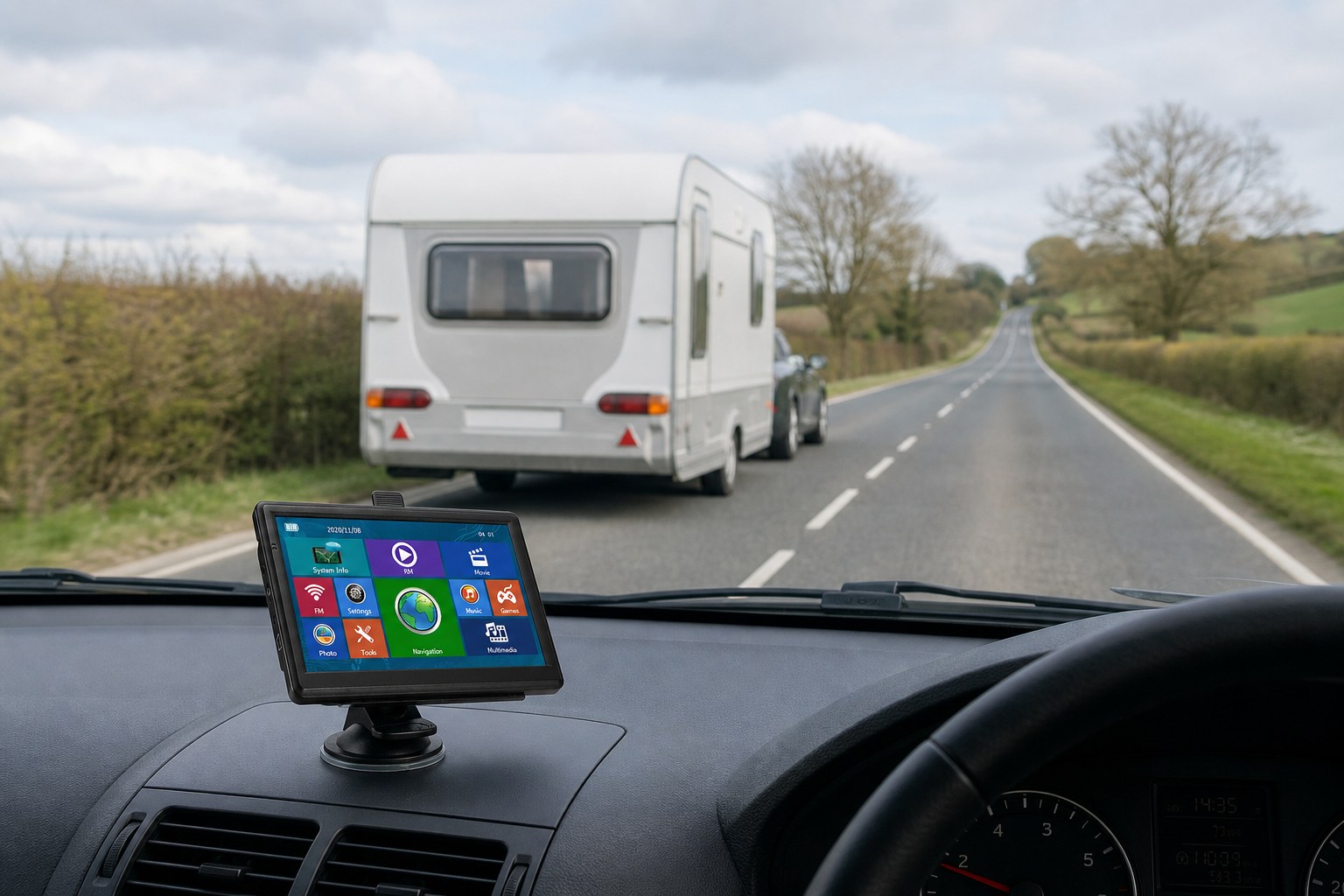
Caravan Sat Nav: UK Buyer's Guide
Short answer: This guide is for drivers comparing navigation for a car-and-caravan outfit. Start with vehicle, mounting, power and map requirements, then compare them with the product page. Do not assume a routing guarantee from the name of a profile or article.
What this guide covers
- The route topic and URL are matched to Caravan Sat Nav: UK Buyer's Guide.
- Product references stay within the stated 7-inch, Bluetooth, AV-IN and European map-region facts.
- Suitability and routing decisions remain subject to vehicle details, road signs and current restrictions.
Use the checks below in order. If a required profile, mounting detail, connection or map term is not stated, confirm it before ordering rather than inferring it from the article title.
A direct answer for this route
The product page does not state a dedicated caravan profile or guarantee route-database coverage. Confirm the required profile before ordering and cross-check every proposed route against road signs and restrictions. The product itself is a portable 7-inch navigator with Bluetooth, 2.5 mm AV-IN and the European map version.
Start with the complete caravan outfit
Record the combined length, width, height and weight of the towing vehicle and caravan. Confirm before ordering that the navigation software provides a suitable vehicle profile and accepts every dimension that matters to the outfit.
Vehicle fit covers the required profile and dimensions. Installation covers mounting and power. Map terms cover the selected region and any essential software or licence detail. A proposed route is guidance, not permission to use a road. Check every route against signs, temporary restrictions and the limits that apply to the complete outfit.
Current product facts to check
The product page describes the following hardware and selected map region:
- Portable 7-inch GPS navigator; 800 × 480 capacitive display; 8 GB storage; Bluetooth; 2.5 mm AV-IN; 3.5 mm earphone connection; European map version.
| Product page | 7-inch GPS Navigator with Bluetooth, AV-IN and European Maps |
|---|---|
| Current detail price | £176.76 when this guide was checked; recheck before ordering |
| Guide focus | Caravan Sat Nav: UK Buyer's Guide |
| Map selection | Free lifetime map updates are included. Updates may be applied manually via USB or the TF card. |
A repeatable decision process
- Define the vehicle. Confirm that a suitable vehicle profile is available for the complete car-and-caravan outfit.
- Check installation. Confirm which combined dimensions and weight fields the software accepts.
- Check the map terms. Confirm the supplied map region and ask about software, version and licence if those details matter.
- Confirm unresolved details. Plan a secure mounting position that does not obstruct the driver’s view.
- Review the route. Cross-check every proposed route against signs, restrictions and the vehicle’s actual dimensions.
This process keeps the comparison tied to the actual vehicle and journey instead of a generic feature count.
Questions that expose a poor fit early
- Does the available vehicle profile accept every dimension and weight field required for this use?
- Is the supplied mount suitable for the intended vehicle and position?
- Are the power connection and electrical ratings confirmed before ordering?
- Is the European map region sufficient, and are any essential software or licence details stated?
- Can every proposed route be checked independently against signs and restrictions?
Routing and suitability boundary
The product page does not state a dedicated caravan profile or guarantee route-database coverage. Confirm the required profile before ordering and cross-check every proposed route against road signs and restrictions.
Build a small topic path
Continue with the guide that matches the next vehicle or planning question; each route has a distinct topic.
Frequently asked questions
Does this product state that it has a dedicated caravan profile?
No dedicated caravan profile is stated. Contact support before ordering to confirm that the available vehicle profiles accept the combined dimensions and weight you need.
What map region is supplied?
The product is sold as the European map version, with UK coverage listed. This describes the map region, not a mains plug or a promise about software, version, licence or update entitlement.
Can a caravan route be followed without further checks?
No. Treat every proposed route as guidance and check it against current road signs, temporary restrictions and the limits of the complete outfit.
What hardware does the product page describe?
It describes a portable 7-inch navigator with an 800 × 480 capacitive display, 8 GB storage, Bluetooth and a 2.5 mm AV-IN connection.