Free Tracked UK Delivery on All Orders - Shop the Professional Range

Best Truck Sat Nav Explained: A UK Buyer's Guide

Best Truck Sat Nav Explained: A UK Buyer's Guide
Written by Chloe E.2026-05-1813 min read

If you drive an HGV, van or mixed fleet vehicle in Britain, the best truck sat nav is not just about getting from A to B. It is about route legality, bridge safety, delivery efficiency and keeping your day moving when the wrong turn could mean reversing out of a country lane or facing a low bridge with nowhere to go. A standard car sat nav can be fine for private motoring, but it often falls short for professional driving.

At TruckNav, the focus is simple: Navigate the UK with Professional Confidence. That means route guidance designed for HGVs, vans and cars, with practical tools to help drivers avoid low bridges, narrow lanes and unsuitable roads with less stress.

This guide explains what really makes the best truck sat nav for UK drivers, which features matter most, and how to choose a unit that fits your vehicle, working pattern and budget.

Key Takeaways

  • The best truck sat nav should route by vehicle size, weight and road restrictions, not just postcode.
  • UK-specific mapping matters, especially for low bridges, width limits, weight limits and narrow rural roads.
  • Live traffic, speed limit alerts and clear lane guidance can save time and reduce pressure during long shifts.
  • Screen size, mounting stability and ease of use in the cab are just as important as route planning.
  • Professional drivers should look for regular map updates and dependable route recalculation.
  • If you also tow or use other specialist vehicles, related guides such as The Ultimate Guide to Caravan Satnav in the UK can help you compare use cases.

Why a truck sat nav matters more in the UK

British roads create a particular challenge for larger vehicles. Motorways and major A-roads are one thing; town centres, industrial estates, old village routes and urban delivery points are another. Many roads across the UK were never designed for modern heavy vehicles, and one poor route choice can cause delays, missed slots, vehicle damage or fines.

The Department for Transport reports that in Great Britain there were 1.35 billion vehicle miles travelled by HGVs in December 2024 alone, which underlines the scale of freight movement on UK roads and the importance of reliable routing tools for professional drivers (source: Department for Transport road traffic estimates).

That volume of movement is exactly why the best truck sat nav needs to do more than offer the shortest route. It should help drivers avoid known restrictions and choose roads that are realistic for the vehicle they are actually driving.

In practical terms, that means fewer encounters with low railway bridges, fewer diversions through residential streets and less time spent second-guessing whether the next turn is suitable for a 44-tonne artic, a rigid lorry or a large delivery van.

What makes the best truck sat nav?

The answer is not one single feature. The best truck sat nav combines vehicle-aware routing, reliable mapping and a cab-friendly design that works well during a real working day. Here is what to assess before you buy.

Vehicle-specific routing

This is the core feature. A proper truck sat nav lets you enter key vehicle details such as height, width, length, weight and, in some cases, load type. The system then uses those dimensions to avoid roads that are likely to be unsuitable.

For UK operators, this matters because low bridges, width restrictions and weight limits are common, especially around older towns, rail crossings and rural routes. If a device cannot route around those hazards intelligently, it is not really doing the job of a truck sat nav.

Low bridge and restricted road avoidance

Low bridge avoidance is one of the biggest reasons drivers move away from standard car navigation. Bridge strikes remain a serious issue in Britain, causing disruption, repair costs and safety risks. The best truck sat nav should make bridge data visible and route around conflicts based on your entered vehicle height.

It should also help with narrow lanes, weak bridges, environmental restrictions and roads where turning or access is difficult for longer vehicles.

Accurate UK mapping

Not all mapping quality is equal. A unit aimed at European touring may still be weak on the detail that matters most in Britain. Strong UK coverage should include industrial areas, delivery zones, road classifications, speed limits and common commercial restrictions.

If your work involves frequent urban drops, multi-stop routes or travel between depots and customer sites, mapping accuracy becomes even more important than headline features on the box.

Live traffic and route recalculation

Traffic conditions can ruin a carefully planned schedule. A worthwhile truck sat nav should offer live traffic information and quick rerouting when delays build up ahead. That does not mean every diversion is better, but it gives the driver more useful options.

For operators dealing with timed deliveries, retail distribution, port traffic or NHS-related transport work, current road information can make a meaningful difference to punctuality and driving stress.

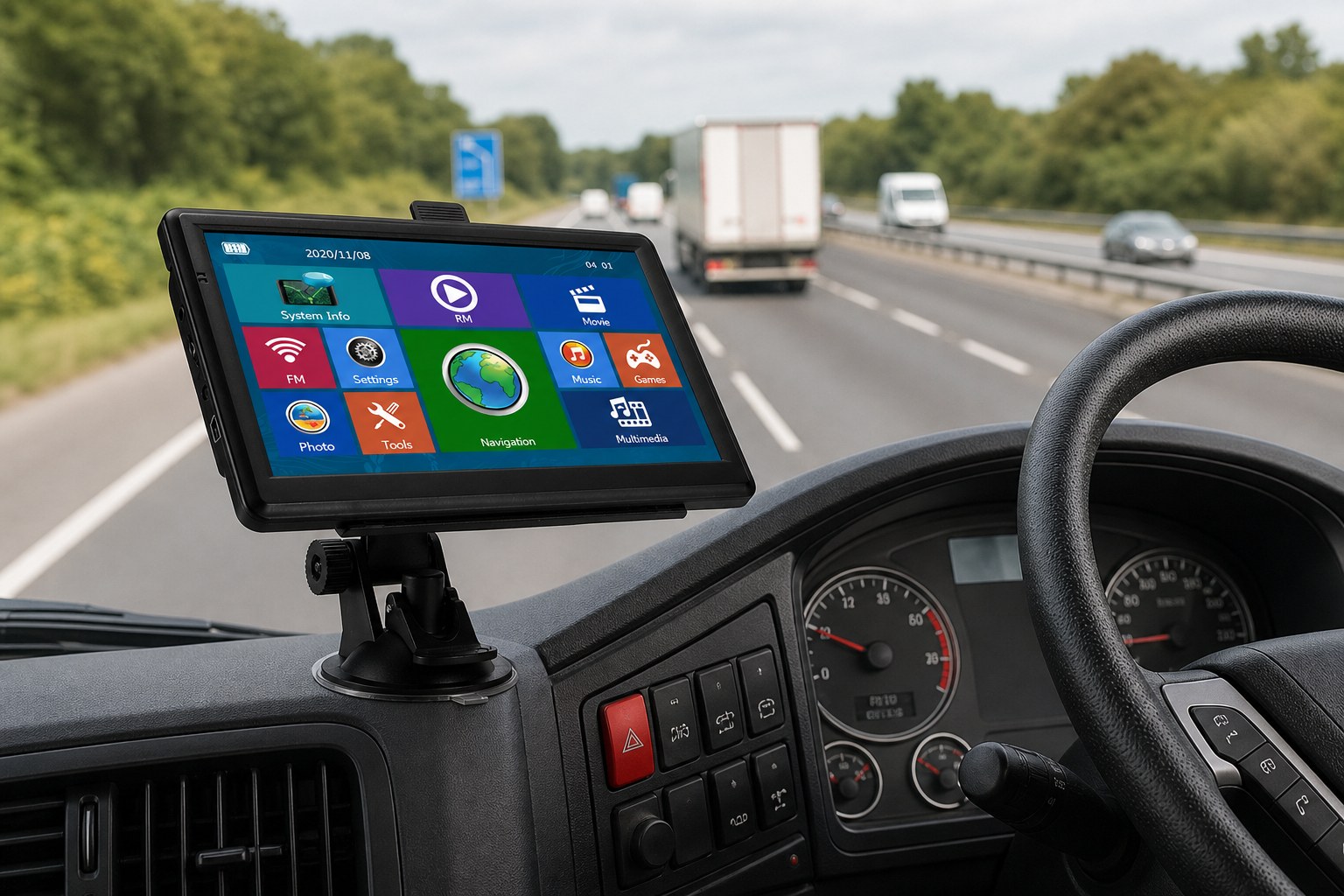
Large, readable screen

In a working cab, visibility matters. A clear screen with readable junction views, lane guidance and obvious alerts reduces the need to glance repeatedly at the device. Many drivers prefer a larger display because it is easier to read quickly without distraction.

That said, a bigger screen should still mount securely and not interfere with legal visibility or cab ergonomics.

Simple menu layout

The best truck sat nav is not the one with the longest feature list. It is the one you can operate confidently at the start of a shift and during breaks without wading through clumsy menus. Fast address entry, easy profile switching and clear route summaries save time.

Reliable updates

Road networks change. New housing developments, altered junctions, revised speed limits and local restrictions can all affect route quality. Regular map updates are a basic requirement, not a premium extra, for professional navigation.

Who should buy a dedicated truck sat nav?

The best truck sat nav is not only for long-haul HGV drivers. It can also be a smart buy for a wide range of UK road users whose vehicles are larger than average or whose work depends on predictable routing.

HGV drivers and haulage operators

This is the most obvious group. If you drive artics, rigids or specialist heavy vehicles, a truck-specific device can reduce route risk and improve confidence on unfamiliar roads.

Courier and delivery van drivers

Large vans can face many of the same challenges as lorries, especially in city centres, older residential streets and rural delivery areas. If your van regularly meets width or height constraints, a truck sat nav can be more useful than a standard car device.

Mixed fleet businesses

Some businesses run a mix of HGVs, vans and company cars. In that situation, navigation that supports different vehicle profiles can be a practical way to improve route planning across the fleet.

Drivers who tow or use specialist vehicles

If you also tow trailers or use motorhomes and caravans, it is worth understanding how specialist navigation differs by use case. Our guide to The Ultimate Guide to Caravan Satnav in the UK explains what to look for when dimensions and route suitability are essential beyond freight work.

Features that separate a decent unit from the best truck sat nav

Custom vehicle profiles

If you switch between vehicles, custom profiles are extremely useful. A driver may use one profile for a high-roof van, another for a rigid, and another for an artic combination. This avoids the risky habit of using one generic setup for every job.

Lane guidance and junction views

Complex motorway junctions and urban multi-lane systems can be hard enough in a car, let alone in a heavy vehicle with limited room to correct mistakes. Good lane guidance helps you commit early and avoid dangerous last-minute manoeuvres.

Postcode and full address precision

In the UK, postcode navigation is useful but not always enough. Industrial estates, farms, depots and service yards can require more precise destination entry. A device that handles full addresses and points of interest well will usually serve professional drivers better.

Points of interest for professional drivers

Useful points of interest may include fuel stops, services, parking, loading areas and rest locations. If your work requires regular breaks or overnight planning, these can make route management much easier.

Speed limit awareness

Clear speed limit display is valuable, especially when moving between roads with changing limits. Drivers should always rely on road signs and legal requirements first, but a good sat nav can provide an extra layer of awareness.

Strong mounting and power options

Cab practicality is often overlooked in online buying guides. A device can have excellent software and still become irritating if the mount vibrates, the cable arrangement is awkward or the unit is difficult to position safely. The best truck sat nav should feel fit for daily use, not just occasional journeys.

How to choose the right model for your work

Buying the best truck sat nav starts with your own driving pattern. The right choice for a national haulier may not be the right one for a local trades business or multi-drop van operator.

Consider your vehicle size and load

Start with the dimensions you actually use day to day. Height is often the first concern because of bridge risk, though width, length and weight are equally important on many routes.

Think about where you drive most often

Urban deliveries demand strong traffic handling and detailed local mapping. Long-distance motorway work may place more value on route stability, live updates and service stop information. Rural work often makes restricted road avoidance a top priority.

Decide whether you need one device for several vehicles

If the sat nav will move between drivers or vehicles, profile management and ease of setup matter more. The best truck sat nav for a fleet environment should be straightforward enough that drivers can trust it without extensive training.

Balance upfront cost against daily value

A cheaper unit can cost more in the long run if it leads to delays, unsuitable routes or poor reliability. For professional driving, navigation is operational equipment. If a better device prevents one serious routing mistake, it may justify the price difference quickly.

Common mistakes buyers make

Many sat nav purchases disappoint not because the device is faulty, but because the buyer chooses the wrong type of navigation for the job.

Buying a car sat nav for HGV work

This is still one of the biggest mistakes. Car navigation is built around private motoring assumptions. It does not consistently account for bridge heights, road widths or lorry-specific restrictions in the way a dedicated truck sat nav should.

Ignoring update policy

If map updates are difficult, expensive or infrequent, the device may age quickly. In a fast-changing road environment, outdated navigation can become a liability.

Choosing based on screen size alone

A large display is useful, but it does not compensate for poor route logic. Prioritise route quality first, then screen comfort.

Not checking UK suitability

A model that performs well in generic reviews may not be the best truck sat nav for British conditions. UK road quirks, local restrictions and postcode habits make local suitability essential.

How TruckNav fits the needs of UK drivers

TruckNav is built around a practical promise: Navigate the UK with Professional Confidence. For drivers who need dependable route guidance across HGVs, vans and cars, the value lies in making journeys safer and less stressful by helping avoid low bridges and narrow lanes with ease.

That is especially relevant in Britain, where route suitability can change quickly between motorways, town centres, business parks and older local roads. A navigation tool designed with those realities in mind is far more useful than a generic system that simply aims for the fastest line on the map.

If you are comparing specialist navigation options more broadly, our article Truck Sat Nav Explained: A UK Buyer’s Guide gives extra detail on what separates truck-specific systems from standard alternatives. For drivers who also use leisure vehicles or tow outside work, The Ultimate Guide to Caravan Satnav in the UK is another helpful reference point.

Expert buying checklist: what to confirm before you order

  1. Can you enter vehicle height, weight, width and length?
  2. Does it support UK truck restrictions and low bridge avoidance?
  3. Are map updates included or straightforward to maintain?
  4. Does it offer live traffic and reliable rerouting?
  5. Is the screen easy to read in daylight and low light?
  6. Can it store multiple vehicle profiles?
  7. Is the mount secure enough for daily professional use?
  8. Does it feel quick and simple to operate during a working shift?
  9. Is it clearly suited to HGVs, vans and other larger vehicles in the UK?

Best truck sat nav: final verdict for UK buyers

The best truck sat nav is the one that helps you make safer, more practical decisions on British roads every day. For UK drivers, that means accurate vehicle-based routing, low bridge and narrow lane avoidance, strong local mapping, clear guidance and dependable updates.

It should reduce uncertainty, not add another layer of distraction. It should fit how professional drivers actually work, whether that means long motorway runs, city-centre drops, rural collections or mixed-vehicle use across a business.

If your current sat nav leaves you worrying about bridge heights, struggling through unsuitable lanes or second-guessing every unfamiliar turn, it is probably time to upgrade to a solution built for the realities of UK driving.

Ready to navigate the UK with professional confidence?

Choose a sat nav designed for HGVs, vans and cars, and make route planning easier on roads where vehicle restrictions matter. Explore the TruckNav range and find a model built to help you avoid low bridges and narrow lanes with confidence.

Shop TruckNav products

For more specialist guidance, you can also read Best Satnav For Motorcycle Explained: A UK Buyer’s Guide and revisit The Ultimate Guide to Caravan Satnav in the UK for other vehicle-specific navigation needs.

Frequently Asked Questions

What is the best truck sat nav for UK roads?

The best truck sat nav for UK roads is one that supports vehicle-specific routing using your lorry or van’s dimensions, provides reliable UK mapping, helps avoid low bridges and narrow lanes, and offers clear turn guidance with regular updates. The right choice depends on your vehicle type, routes and whether you need one device for multiple profiles.

Is a truck sat nav better than using a phone app?

For professional driving, a dedicated truck sat nav is usually the better option because it is designed around larger vehicle restrictions. Many phone apps are fine for general motoring, but they may not account properly for HGV height, width, weight and route suitability on British roads.

Do van drivers need a truck sat nav?

Not every van driver does, but it can be very useful for larger vans, high-roof vehicles and drivers who regularly work in tight urban areas or on rural routes. If standard navigation often sends you down narrow lanes or towards restricted roads, a truck sat nav is worth considering.

Can a truck sat nav help avoid low bridges in the UK?

Yes, that is one of the main reasons to buy one. A proper truck sat nav lets you enter your vehicle height and should route around unsuitable bridges where mapping data supports it. Drivers must still pay attention to road signs and legal restrictions, but a good unit adds an important layer of route protection.

Ready to upgrade your cab with TruckNav?

Shop Now — £176.76