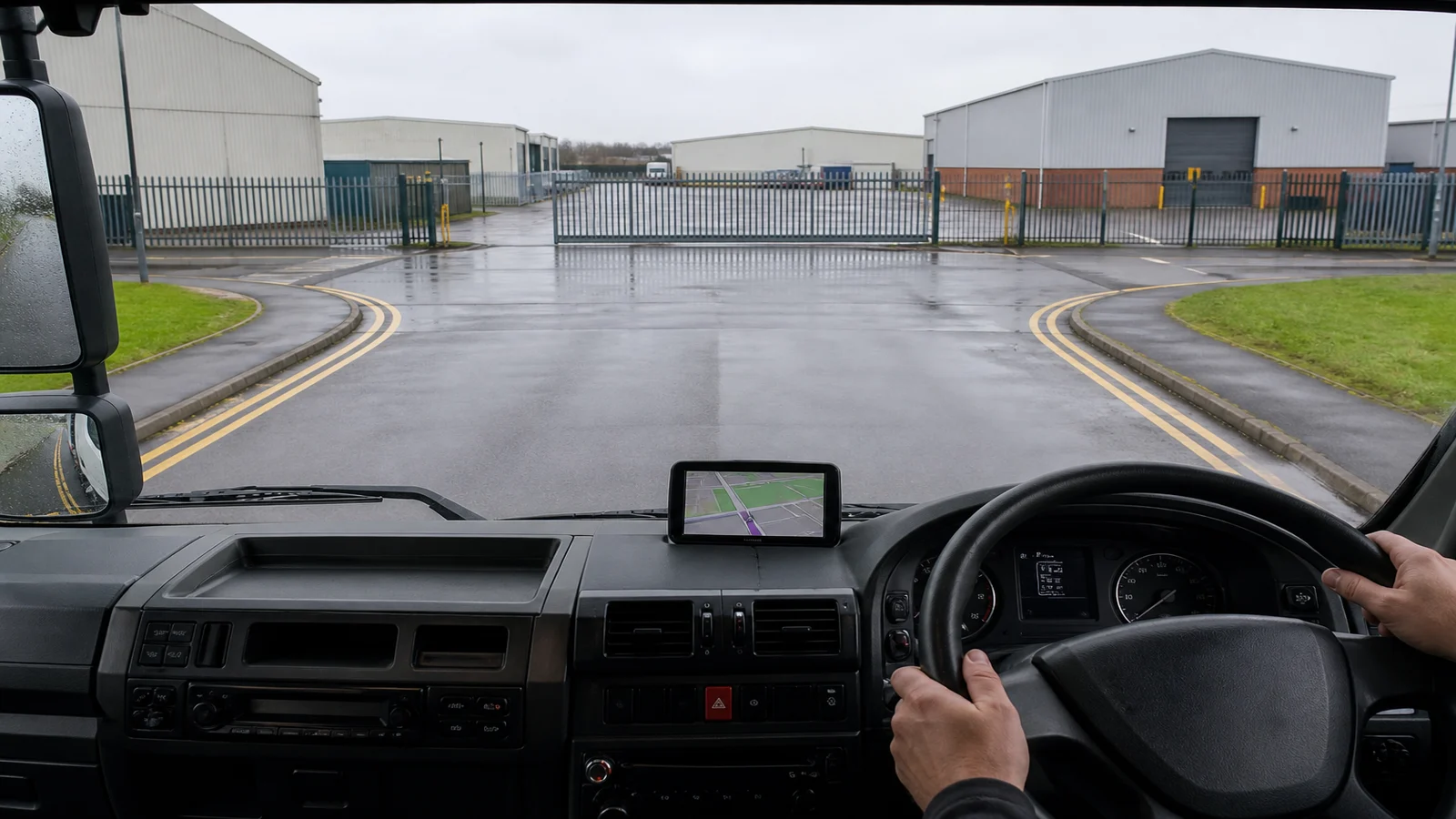
Lorry Delivery Site Access Checklist UK
Confirm the final mile with the site, not just the postcode. A sat nav can bring you to the right street and still leave you facing a gate, a low bar, a tight yard or a kerb you cannot use. Share the vehicle and load facts, ask about turning and timing, and agree what happens if the entrance is wrong before you commit the combination to the approach.
What should I confirm with the delivery site before setting off?
Confirm the physical path from the public road to the place you will stop, not only the address on the booking. Speak to the site or the operator who has already delivered there, and write the answers on the same sheet as the postcode.
- Which entrance to use, including any one-way service road or height bar that does not appear on a map pin.
- Whether the vehicle can wait off the carriageway if the gate is shut or the dock is occupied.
- The booking slot, and whether arriving early is treated as blocking the yard.
- Who meets the driver, and a phone number that works at the gate rather than a switchboard that closes at 16:00.
- Any on-site speed, banksman or PPE rule that will delay the last fifty metres.
HSE's work-related road safety pages treat driving for work as more than getting there on time. A site that can only be entered by reversing blindly into live traffic is a workplace risk, not a navigation inconvenience.
Why is a postcode not enough for the final approach?
A postcode marks a cluster of buildings. It does not tell you which kerb is droppable, whether the sat nav will prefer a residential cut-through, or whether the last corner has a signed width or weight limit. DfT's Know your traffic signs guidance is what you will actually meet on that last road; the pin on the screen is not a substitute for those signs.
Industrial estates often share one postcode across several units, with a short inner road that looks fine for a van and fails for a long rigid or an artic. Farms, building sites and retail parks add temporary surfaces, parked cars and barriers that were not there when the map was compiled. Treat the postcode as the start of the access question, not the end of it.
Which vehicle and load details should I share?
Share the combination you will actually arrive in, including anything that changes height, width or the way the vehicle must be unloaded. DVSA guidance on securing loads on HGVs and goods vehicles makes operators, drivers and consignors responsible for a stable load; a site that cannot take the vehicle is also a place where a rushed unload becomes a load-security problem.
- Overall length, width and measured running height, including roof equipment and the load if it sits above the body.
- Plated weights and whether the vehicle is rigid, tractor and trailer, or a drawbar.
- How the load must come off: rear, side, crane, pump, or tail-lift on level ground.
- Whether the load is live, loose, hazardous or needs a forklift the site may not have.
- Any extra time needed to sheet, unsheet or move pallets before the vehicle can leave.
Do not describe a smaller vehicle than the one that will turn up. A site that says “yes” to a 7.5 tonne picture and then meets an artic has not agreed access.
What should I do if the planned entrance is blocked or unsuitable?
Do not pick a second entrance from the map. Park legally off the approach if you can, then call the site and the operator with what you can see: a shut gate, a parked car across the swing, a signed restriction, a surface you will not commit the trailer to, or a dock that needs a reverse you cannot see.
If the site offers “just come round the back”, walk or wait for a banksman before you commit the combination. If they offer a public road as a waiting place, check whether that road is signed as unsuitable or would block other traffic. If neither a safe wait nor a confirmed alternative exists, do not start an improvised multi-point turn in a live junction.
When should I stop outside and call the site?
Stop outside and call the site when you cannot see a place to enter, turn and leave without using the far kerb, a pedestrian route or a signed restriction. Stop when the last road is narrower than the vehicle, when a height bar is unsigned on the device but visible ahead, or when the only remaining move is a blind reverse toward people or parked cars.
Stay with the vehicle in a legal position while you wait for an answer. Do not leave an HGV partly on the carriageway “just while you check”. If the site cannot give a safe method, the delivery is not ready; the operator decides the next booking, not the magenta line.
Final-mile access checklist
- Call the site with the real combination, not the postcode alone.
- Name the entrance, the waiting place and the unload method.
- Check the last public road for signed height, width, weight or access limits.
- Agree a hold point if the gate is shut.
- Park and call if the view ahead does not include a way in, a way round and a way out.
Who this article is not for
This article is not for van drivers delivering to a kerbside that needs no yard, and it is not a promise that a truck sat nav can certify site access. It is also not a substitute for the operator's load-security procedure on the vehicle.
Stop conditions
Stop rather than attempt the entrance if you cannot see a way to turn and leave. Stop if a signed restriction disagrees with the device. Stop if the site wants an improvised reverse into live traffic or an unload that would leave the load unstable. Call the site and the operator from a legal waiting place.
If a portable unit is still useful for the public-road part of the job, you can review the 7-inch automotive navigation system. Use it to reach the area, then let the site answers decide the last metres. When a restriction sign appears on that last road, follow HGV road restriction signs in route planning.