Why Van and Truck Drivers Still Buy a Dedicated Sat Nav
Drivers still buy a dedicated sat nav because a phone is a shared computer that overheats, drops offline maps, throws notifications, and sits awkwardly in a cheap mount — while a purpose-built portable unit keeps navigation on a larger screen with vehicle modes, a proper suction mount and fewer distractions. That is a kit decision, not a debate about which app draws the cleverest line on a map.
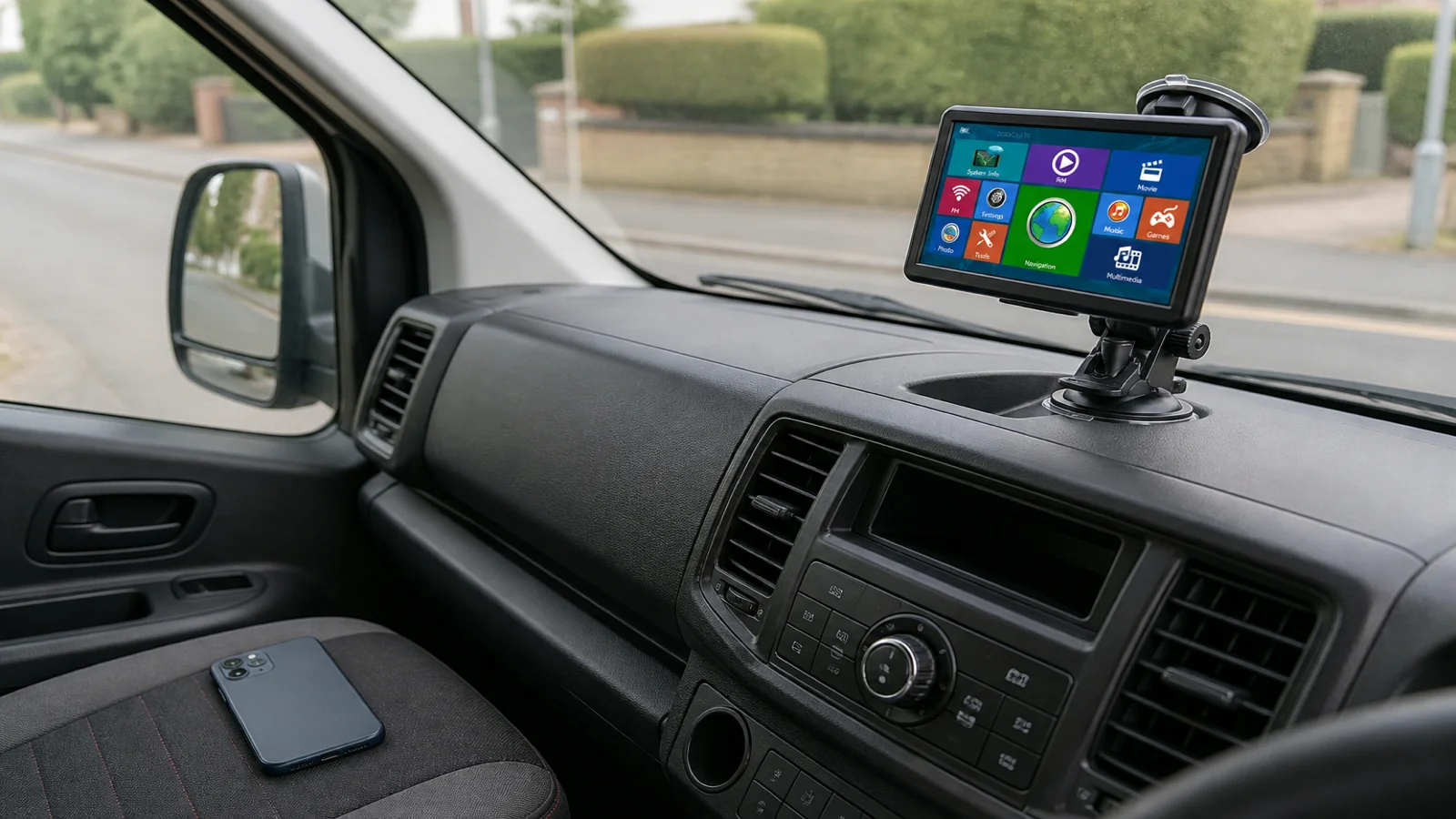
For many UK van and truck operators the question is practical: what stays readable, powered and reasonably quiet across a day of postcodes, industrial estates and unfamiliar junctions? A portable 7-inch GPS navigator such as the TruckNav unit is one answer.
Phone problems that show up on real shifts
Heat. A handset running bright navigation, mobile data and background apps on a summer dashboard gets hot. When it protects itself, the screen dims or the app stutters just as you need a lane prompt.
Offline gaps. Phone navigation often assumes a data connection for parts of the experience. Coverage holes on A-roads, in cuttings, or on large sites still happen. A dedicated unit that carries European maps with UK coverage on the device is built around that offline habit. TruckNav states IGO or Navitel maps with free lifetime updates.
Notification noise. Messages, email and system alerts compete with turn instructions. Every tap to dismiss something is a moment your eyes leave the road.
Mount and cable clutter. Phones are thin, glossy and easy to knock. Charging leads fail. A sat nav designed for windscreen or dash mounting, with a vehicle charger in the box, is a more stable daily tool for many cabs.
A phone remains useful for other tasks. Dedicated hardware still earns a place when navigation is a job function rather than an occasional holiday aid.
What a dedicated 7-inch portable unit offers
Judge listed hardware, not marketing poetry.
- Screen: a 7-inch 800×480 capacitive touchscreen is large enough for clear glances and gloved taps in a cold yard.
- Maps on board: European maps with UK coverage support postcode, address and POI search without tying every glance to a signal bar. Maps are IGO or Navitel, with free lifetime updates; still verify routes against road signs.
- Guidance aids: 2D and 3D views, lane guidance, voice navigation and speed-camera alerts reduce last-second lane panic on busy approaches.
- Vehicle modes: seven modes (car, bicycle, ambulance, bus, taxi, truck and walking) stop you navigating a rigid as if it were a hatchback. There is no dedicated motorhome profile.
- Profiles: entered height, width and weight feed the router — still subject to map data quality and always secondary to road signs.
- Cab basics: Bluetooth hands-free calling and an FM transmitter help keep the handset in a pocket where that setup works for you.
- Rear visibility kit: AV-IN via 2.5 mm plus a compatible 12V rear-view camera in the box supports low-speed reversing when correctly installed; it is not a substitute for mirrors or a banksman.
- Storage and platform: 8 GB internal storage plus a 32 GB TF card, an MSTAR 2531 A7 dual-core 800 MHz processor, Windows CE 6.0 and a 1200 mAh battery describe a self-contained appliance.
- In the box: GPS unit, 32 GB TF card, camera, vehicle charger, USB cable, suction mount, back clip and manual — pieces drivers forget to budget when they “just use the phone”.
Distraction, mounting and honest limits
A suction mount and back clip sound mundane until a phone slides into the footwell on the sixth drop. Dedicated mounts keep the display in one place. Voice prompts help keep eyes up. Bluetooth calling reduces the urge to cradle a handset under your chin at a gate. An FM transmitter can be a workable audio path in older vans without a tidy Bluetooth head-unit link; results vary with interference, but the navigator is designed to live in the vehicle.
Set the correct vehicle mode before you move. Enter honest height, width and weight for today’s combination. Preview the route. Use lane guidance as a hint, not as permission to occupy a forbidden lane. At roadworks, follow temporary signs and legal restrictions, then recalculate only when stopped somewhere safe.
Always follow road signs, legal restrictions and current traffic conditions. Dimension-aware routing does not invent missing restrictions, and a portable camera does not see around solid walls. Dedicated hardware reduces friction; it does not remove professional responsibility.
Who this purchase still suits
Strong fit: multi-drop van drivers who want a big, fixed screen; truck and bus drivers who need vehicle modes and dimension fields in daily view; motorhome users who should not leave navigation to a passenger’s phone; operators who lose data signal and prefer maps on the device; drivers who want Bluetooth or FM options and a simple suction mount.
Weak fit: drivers who already run a managed phone mount, heat plan and offline workflow they trust; users who need rich smartphone apps beyond navigation; buyers who need live traffic, or anyone unwilling to learn a Windows CE-style interface and manual file habits for map updates.
Where this applies — and where it does not
Applies when: you are deciding whether to add a portable sat nav to a working van or truck cab in the UK; your pain points are heat, offline use, notifications and mounting; you want hardware features actually listed on a 7-inch European-map unit.
Does not apply when: you are choosing between two phone apps’ routing styles; you need a factory-fitted multi-camera fleet system; you only drive familiar local rounds; you need live traffic or a factory-fitted fleet system.
Short FAQ
Will a dedicated sat nav stop my phone overheating?
It can remove navigation load from the phone if you use the dedicated unit as the primary display. The handset may still heat up in the sun for other tasks.
Do I still need a phone in the cab?
Usually yes, for calls, photos, depot apps and emergencies. The sat nav holds the map and prompts; Bluetooth can reduce how often you handle the handset.
Is the included rear-view camera automatic?
The facts describe AV-IN and a compatible 12V camera in the box. Do not assume automatic reverse cut-over unless a product states it.
Can I move one unit between vehicles?
Yes in principle: change mode and profile, remount with the suction mount or back clip, and power from the vehicle charger. Re-check height, width and weight whenever the vehicle or load changes.
If a larger dedicated screen, onboard European maps with UK coverage, vehicle modes, dimension profiles, suction mounting, Bluetooth, FM transmitter and an included rear-view camera kit match how you work, review the TruckNav 7-inch automotive navigation system and confirm the listed map and camera facts on the product page before you buy.