Who Should (and Shouldn’t) Buy a Budget WinCE Portable GPS?
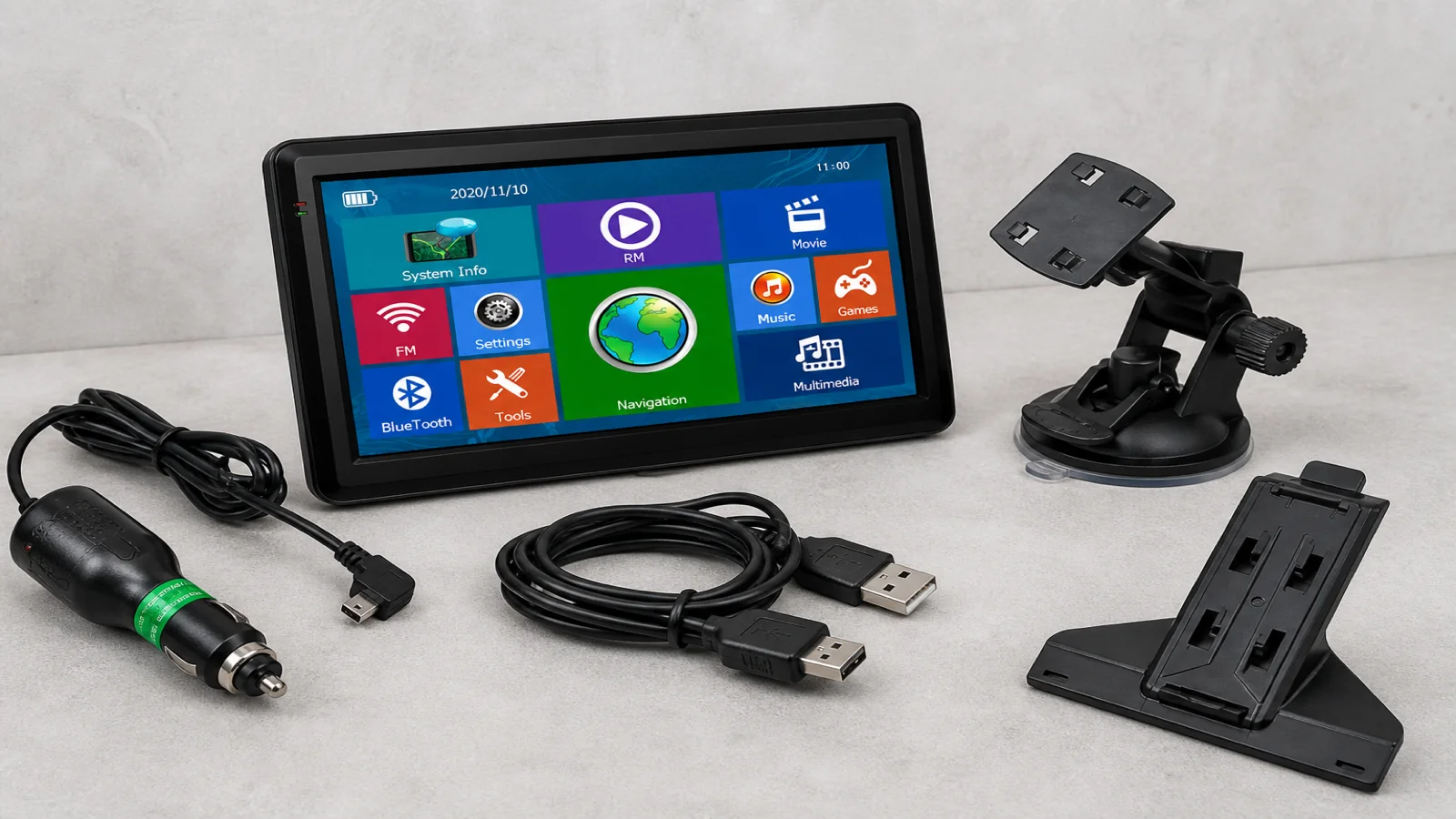
A budget Windows CE portable GPS suits drivers who want a dedicated 7-inch screen, offline-aware vehicle modes, and offline map use as a backup — not buyers chasing smartphone polish or live traffic. TruckNav states free lifetime map updates; they are typically copied manually. The TruckNav 7-inch unit (800×480, MSTAR 2531, WinCE 6.0, 8 GB plus a 32 GB TF card) is a practical tool when you accept older UI pacing, keep it on the vehicle charger, and still obey road signs over any route line.
Who it is for
- Van and light HGV drivers who need entered height, width and weight in a vehicle profile, plus modes that include truck and bus rather than car-only phone defaults.
- Multi-drop crews who want postcode, address or POI search on a fixed windscreen mount without draining a phone that also runs the scanner and messaging apps.
- Drivers crossing into Europe who value European maps with UK coverage on a device that is not tied to one handset’s roaming plan — maps are IGO or Navitel, with free lifetime updates that are typically copied manually.
- Fleets and shared cabs that prefer a suction mount or back clip unit anyone can plug into 12V, with Bluetooth for hands-free calls and FM where there is no AUX.
- Anyone building an offline backup for tunnels, rural yards and weak signal days, while still using mirrors, signs and site instructions for the last metres.
If that list sounds like your week, a dedicated sat nav earns its keep even when the menus feel dated compared with a modern phone.
Who should look elsewhere
- Buyers who need glass-smooth animation and app-store ecosystems. WinCE 6.0 on an 800 MHz-class MSTAR 2531 will feel slower than a current smartphone; occasional lag when rotating 2D/3D views or opening lists is a fair expectation, not a defect to “surprise” you later.
- Anyone insisting on live traffic in the product promise. Live traffic is not stated for this unit. Free lifetime map updates are stated; they are typically copied manually via USB or TF card.
- Drivers who want automatic reverse-camera cut-in or night-vision specs. AV-IN (2.5 mm) and a 12V rear camera are included, but you switch input manually and night viewing depends on vehicle lighting.
- Users who expect door- or gate-level pinning from a UK postcode alone. Search helps you reach the estate; the right shutter still needs the full address, site notes and your eyes.
- People who refuse to use a vehicle charger. The 1200 mAh pack is a buffer, not an all-day untethered laptop battery.
Stutter and UI expectations on WinCE
Budget portable GPS hardware of this generation prioritises navigation functions over fluid UI. Voice guidance, lane guidance prompts, speed-camera alerts, and mode switching are the point. Pinch-zoom theatrics and instant POI browsing are not. Give the unit a moment after cold start, avoid hammering the capacitive screen with wet gloves, and keep storage tidy — 8 GB onboard plus a 32 GB TF card is ample for maps if you are not treating the card like a media dump.
Vehicle modes cover car, bicycle, ambulance, bus, taxi, truck and walking the last stretch on a large site. There is no dedicated motorhome profile. Wrong mode is a driver error, not a WinCE quirk: switch profile and dimensions when the vehicle changes.
Battery and vehicle charging reality
Plan around the cigarette-socket (or equivalent) charger for road work. The 1200 mAh battery covers short stops, moving the unit between a car and a van, or finishing a route if the plug pops out — it is not marketed as a full-shift cordless tablet. Heat on the dash shortens runtime; shade the screen when parked and use the suction cup on clean glass so you are not constantly reseating a loose mount.
Bluetooth hands-free and FM transmitter use add to the load. If you stream calls and FM audio while navigating, keep 12V connected. That habit also keeps the display ready when you briefly open AV-IN for the included rear camera.
Offline backup versus phone-only navigation
Phones excel at messaging and live apps when signal and data exist. A portable WinCE GPS earns its place when the phone is hot, cracked, sharing a weak hotspot, or buried under delivery paperwork. European maps with UK coverage on the device reduce the chance that a rural industrial estate leaves you staring at a spinning network icon. Pair that with lane guidance and voice so you glance less; still treat speed alerts as warnings, not a licence to ignore the posted limit.
Fit checklist before you buy
- You will enter real height, width and weight — including mirrors and roof furniture where they count.
- You accept suction or back-clip mounting and a 7-inch footprint in the cabin.
- You will follow signs over the map when they disagree.
- You want Bluetooth and FM as cabin audio options, not a full aftermarket head unit replacement.
- You understand that this model states free lifetime map updates, typically copied via USB or TF card.
Boundaries worth stating clearly
Free lifetime map updates are included; no live traffic subscription, automatic reverse cut-in, night-vision claim or gate-level geocoding promise is stated. The product is a budget portable navigator with stated hardware and features — not a phone clone and not an OEM integrated system.
FAQ
Is WinCE too old to be useful?
For turn-by-turn use with vehicle modes, dimensions, voice and lane guidance, yes it remains useful. For app-store entertainment, no — buy a different class of device.
Will it replace my phone entirely?
Use it as the dedicated map screen and keep the phone for calls you prefer on the handset, scanning, and anything that needs modern apps.
Is the rear camera only for HGVs?
No. Any vehicle where you wire the included 12V camera and use AV-IN can benefit; install effort scales with vehicle length.
If a budget WinCE portable GPS with truck-capable modes fits your use case, see the 7-inch automotive navigation system on trucknav.co.uk.